Sunday, June 11, 2006

Reckless cooking -- New Blog

Reckless Cooking Blog

Please check my "new" stage for some reckless cooking!

Sunday, May 21, 2006

Payasam recipe over 2000 years old!


JAGANNATH PURI KITCHEN

The World's Oldest Rice Pudding

By Kurma Dasa

There comes a time in every writer's life for an office cleanup. A couple of weeks ago I took the plunge. Hoping to discover a few long-forgotten bits and pieces in the process, I sorted through twenty-six years of accumulated paperwork and files. I wasn't disappointed.

I knew I had many vegetarian recipes stored away, but the final count of over 3000 was indeed a pleasant surprise. Inside one dusty box, I found a collection of very old recipes that I had kept aside, perhaps for some future cookbook. I dug up a recipe for a hundred-year-old apple pie (actually the recipe was a hundred years old, not the pie), and a medieval Swedish cream fudge.

But the recipe that made the two-day cleanup really worthwhile was a 2000 year-old recipe for rice pudding from an old Indian temple kitchen. Yamuna Devi, a friend and celebrated cooking writer had discovered the recipe on one of her numerous trips to the subcontinent, and had written some notes to accompany the recipe.
Here's an excerpt from what she had to say:

"Of all the world's exceptional kitchens, perhaps none are as grand as the kitchen compound of the Jagannatha Temple in Puri, Orissa, that basks on India's eastern seaboard adjoining the Bay of Bengal.

The present temple of Jagannatha was constructed by King Ananga Bhima. Historians say this temple was constructed at least two thousand years ago. Awesome and gigantic, the Jagannatha Temple kitchen reflects centuries, if not millenia, of culinary tradition.

Without electricity or machines, a legion of skilled chefs work under oil lamps over open wood fires. Every day since the temple was inaugurated over twenty centuries ago, the temple chefs have prepared more than one hundred different vegetarian dishes in enormous quantities to be offered to the temple Deities, and then distributed as prasadam, sanctified food. The kitchen runs so efficiently that given only one day's notice, the chefs can prepare a full meal for ten thousand guests at a sitting.

The kitchen compound is located several feet above and to the left of the temple's main gate, called the Simha-dvara, or Lion Gate, and covers roughly one acre. The kitchen is divided into nine sections, two of them a little more than 2,500 square feet each, the other seven slightly smaller.

The kitchen houses an astounding 752 wood-burning clay stoves, called chulas, each about three feet square and four feet high. To accomodate various sizes of pots, small clay knobs are judiciously placed at intervals on the stove's surface for support. A circle of five jug-shaped earthen pots rest directly on the stove's surface, kept in place with the clay knobs. Three more pots go in the open spaces above the pots to form a second layer, and one more pot goes in the centre on top, forming a nine-pot pyramid. In this way, all nine pots receive lickings of heat and smoke from the wood fires below.

Some cooking pots, also made of unfired clay, are shallow and wide, resembling Spanish Paella pans or French saute pans. As the food cooks in the pots, their walls become very hot. The pots provide amazing heat retention - food stored in them stays piping hot for up to four or five hours - and tastes exceptionally delicious.

One thousand men are employed in the kitchen every day. Five hundred executive chefs, called swaras, are the only ones actually allowed to cook on the stoves. Three hundred kitchen assistants, called jogunias, assist the swaras by lighting the fires, fetching water from temple wells, washing and cleaning the new earthen cooking pots before use, and finally filling the pots with ingredients. The other two hundred assistants , called tunias, wash the cart-loads of locally grown vegetables, such as the many varieties of leafy greens, tubers, squashes, melons, green chilies, ginger and fresh coconuts. The tunias also cut the vegetables, grate the fresh coconuts into powder, and stone-grind the herbs, chilies, ginger, and dozens of spice blends. All members of the kitchen staff begin training at age twelve. They serve for life, or until they become too old to perform their duties.

The one hundred different dishes prepared daily fall into two categories, called pakka and sukka. Pakka foods are those which are boiled, such as dals, soups, stews, rice, kiccharis, and all vegetable dishes. Sukka, or dry foods, include cookies, biscuits, sweetmeats, pastries, and confections.

As with the fruits and vegetables selected for use in the Jagannatha kitchens, the standard for spices has also remained constant for two thousand years. Only locally grown spices are used, and these include mace, cumin, fennel, nutmeg, cardamom, cinnamon, coriander, mustard seed, and black cumin.

Although non-Hindus are strictly forbidden from entering the Jagannatha Temple or it's kitchens, visitors to Jagannatha Puri's bustling markets can purchase a huge variety of temple kitchen prasadam for a small price, some still hot and in it's original clay cooking pots."
Not long after rediscovering the recipe, I cooked the rice pudding, and I must say it was delicious. Here then is the original recipe for bhat payasa, the rich rice pudding cooked daily at the Jagannatha Temple kitchen. This recipe has not changed in two thousand years.

2 tablespoons ghee or unsalted butter
3/4 cup long grained rice, washed and dried
1/2 bay leaf
2 litres milk
1/2 cup ground rock sugar, or raw sugar
1/4 cup currants
1/2 teaspoon ground cardamom seeds
one pin-head quantity of pure cooking camphor (optional)
1 tablespoon toasted nuts for garnish

Heat the ghee or butter in a heavy pot over medium heat, and toast the rice for a minute.

Add the bay leaf and milk. Bring to the boil, reduce the heat, and simmer, stirring occasionally, until reduced to half it's original volume.

Add the sweetener, currants, and cardamom, and simmer the mixture until it reaches one fourth of it's original volume, and is thick and creamy.

Stir in the optional camphor, and cool to room temperature, or refrigerate until chilled.

Serve garnished with the toasted nuts. Alternatively, for an untraditional touch, top with a spoonful of pureed sweetened raspberies, strawberries, or red currants.

Original Source

Sunday, April 30, 2006

American Chopsuey & Fruity Choco Dessert

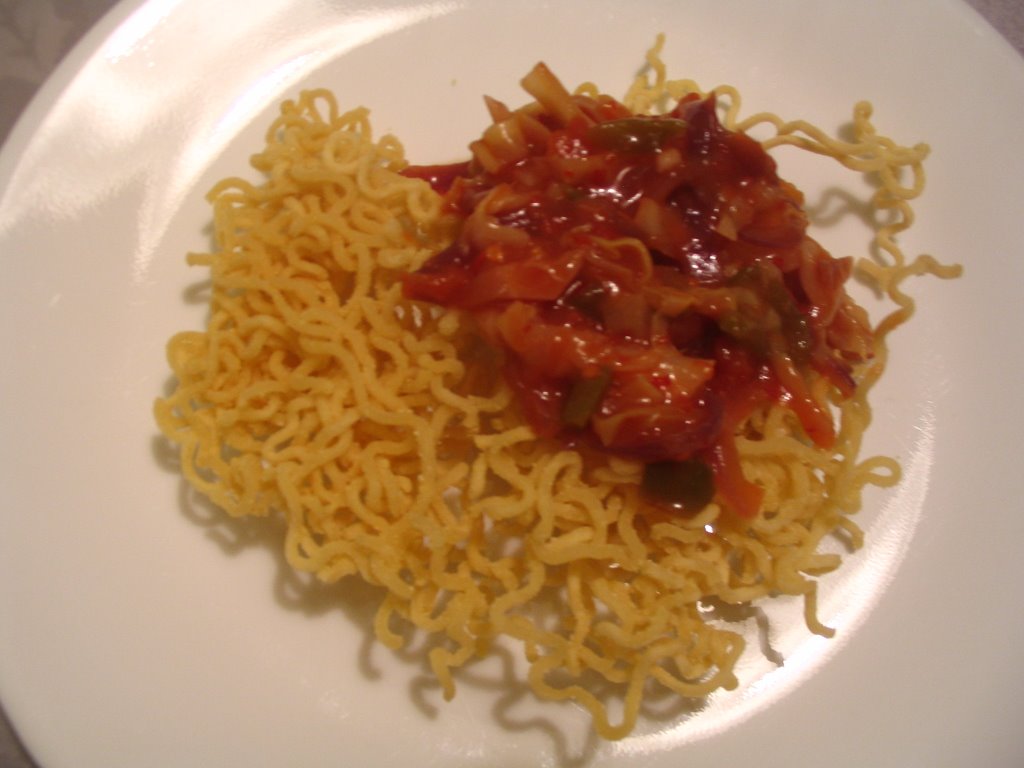
American Chopsuey is a misnomer. It is not really american, more of chinese origin. It is a great recipe for a graduate student who is bound to stock up on Ramen noodles and wants to prepare a fancy meal.


Chopsuey: noodles + corn flour + cabbage + tomato
+ onions + any veggie you like


Fruity-Choco Dessert


Optimized Method of Preparing the meal in less than 40 minutes

Timer begins at 00:00 (m m: s s)

00:00 - Rummage cupboards for 2 pkts of Top Ramen noodles. We are not going to use the accompanying flavor. So choose the one you dislike most. If you have no ramen any other noodle type will work too.

For the dessert we use a ready made cake mix recipe. I like Betty Crocker's products, especially the chocoloate variety.

00:02 - Boil the noodles in a saucepan of water. Add a little salt + oil too.
Prepare the dough for the cake according to the instructions on the packet. Spread the batter in a baking dish, topped with some almonds and pista. Place in the oven.

00:05 - Keep checking the noodles. We don't want it to get sticky. For the sauce, chop some cabbage, 1 onion into long strips. Also can add some french beans and diced carrot.

00:07 - Take the noodles off the stove and drain the water.

00:20 - You should have all veggies ready by now. Remember to use an electric chopper for quick cutting. Heat a pan with some margarine in it. Saute onions on medium heat.

00:23 - Add some red chilly flakes to the onion and stir for a couple of seconds. Then add the rest of the veggies and saute well.

00:24 - Add dry corn flour to the wet noodles and deep fry in oil. This will take some time, so manage the heat accordingly.

00:30 - Time to add the tomatoes to the sauce. Too much tomatoes can never hurt, but too little can. I added about three quarters of a can of diced tomatoes (Hunts) to get that lovely red color. Add salt and stir on medium heat.
Working on frying noodles on the other stove.

00:35 - Add 2 tbsps of vinegar. Mix 2 tsps of cornflour in water and make sure there are no lumps. Add this to thicken the sauce. At this point one should get a good aroma of both the cake and the sauce.
Working on frying noodles on the other stove

00:40 - At this point all 3 dishes should be done. Pour the sauce over the crispy noodles.
I used a tutti-fruity flavored icecream (available in indian stores) to top my chocolate cake. I think the softness of the cake with fruity ice cream is a wonderful dessert after the crispy crunching of chopseuy!

Saturday, April 22, 2006

Indo-Italian Non-Cheese(!!) Dinner

Tired after a long day of work and are now faced with the chore of cooking dinner ? Then how about a Indo-Italian dinner. As always, let us whet our appetite by examining possible results of time spent efficiently in the kitchen. (err..I was truly hungry the night I made this, as evident from the missing end of a bread piece in the picture below)


Spicy Cellentani with Italian Bread & Tomato Ketchup

Cellentani + Dark red Kidney Beans + Tomatoes + Onions
Italian bread (or any forgotten bread in the fridge) + herbs


Optimized Method of Preparing the meal in less than 40 minutes

Timer begins at 00:00 (m m: s s)

00:00 - Add a packet of Cellentani ( I like the Barilla brand) in a pot full of water. Place this on the stove at medium heat. Also add 1 tsp of salt and 1/2 tsp of oil. This allows for the cellentani to absorb the salt from the very beginning. The oil ensures that they don't stick together.

05:00 - Open the can of dark red kidney beans ( a light red variety is also fine, as long as they are kidney beans) and wash them of all their preservatives. This is more popularly known as rajma in Indian cuisine. Add these beans to a saucepan of water and little salt. Place this on the stove at medium heat. Also, cover the saucepan as we want the beans to soften.

10:00 - Now that the beans and cellentani are cooking, prepare the ingredients for the sauce.
Dice 1 large onion (preferably red onion) and 2 red tomatoes (can use canned tomatoes too). I use a little chopper from Black & Decker to dice my onions. Saves me some tears!

15:00 - Get that bread out of your fridge and cut it into the shape that delights you most. I chose triangular cuts as that is about as fancy as I can get. Please, do keep stirring the cellentani and the beans at regular intervals. Take another pan, add some margarine/butter to it. If you like garlic, you can pound 2/3 pods and add that too to the pan. Then immediately, add the bread pieces and fry them. All this on low heat. We don't want charred blocks of carcinogenic disasters now.

22:00 - Check on the beans. They should be soft enough now. Take them off the stove and drain the water.

25: 00 - The bread should be golden brown now. Since, I did claim it was a fusion meal it is time to add some zesty Italian herbs to the bread. I have a ready mixture of basil, oregano et al. So let your imagination run riot. Add all the herbs you have within reach to the bread and stir.

28:00 - Take the bread off the stove. Cellentani should be done by now. Note that we have cooked it for about 1/2 hour, unlike the TV shows where they seem to be magically ready in 10 minutes! Drain the water and get ready to make the sauce.

30:00 - Use the same pan that boiled the cellentani to prepare the sauce. Add margarine + cumin seeds + diced onions and fry well. All this on medium high.

32: 00 - Add red chilly powder + salt + coriander-cumin powder (readily available in any indian stores; better known as dhaniya-jeera powder) and a little garam masala. The quantities of these spices are dependent on your tastes. For the chilli lovers I recommend about 3 tsps of chilly powder.

34: 00 - Add diced tomatoes and beans and stir.

36:00 - Now add the cellentani to the mixture and keep stirring well.

40:00 - Spicy cellentani with no cheese should be ready to eat now. I find it delightful with tomato ketchup and the mildly flavored bread pieces.

Since, this is a true representation of a real time cooked meal I do not pretend that it is also possible to make a dessert within the alloted 40 minutes. At this point, the critics shall go to the freezer and tuck in some yummy ice-cream.

Saturday, April 08, 2006

Tomato Pulusu + Kothavaranga(Chikudikai/Beans Variety) + Mango Milk Shake

Indian cooking is simple and easy. A little thought can go a long way in reducing the time you spend in the kitchen. This write up is a real time presentation of making a meal. Firstly, let us desire to cook - See pics below.

Kothavaranga Curry: Kothavaranga (frozen), grated coconut, red chillies

Tomato Pulusu: Toor dal, tomatoes, green chillies, tarmarind pulp


Mango Milk Shake: Mango pulp (readymade), milk, sugar


Now let us make these 3 dishes in less than 40 minutes!

Optimized Method of Preparing all three dishes in parallel

Timer begins at 00:00 (m m: s s)

00:00 - Fry 1.5 cup toor dal in a pan (without oil) till slightly brown.

03:00 - Place fried toor dal in a vessel and fill with water. Add a little turmeric powder.
In another vessel add kothavaranga (or any beans variety you have), which is usually available in frozen vegetable section. Add salt to this. Place both vessels in a pressure cooker. Cook for about 12 minutes

07:00 - When the veggies are cooking away, prepare rice in rice cooker

10:00 - Time to prepare Mango Milk shake. In a blender, add mango pulp- 4 cups (available in stores) , milk - 3 cups, sugar- 1 cup. Blend well.

15:00 - The cooker will be done by now. Take it off the stove and place it on the counter and let it cool.

18:00 - The milk shake should be done by now. Pour into a container and place in fridge.

20:00 - Should be able to open the cooker. Take out the boiled beans and toor dal.

22:00 - Heat oil + mustard + urad dal + red chillies in a pan. Once the seeds splutter add the boiled beans and let it fry.

26:00 - In another vessel, heat oil + mustard + fenugreek seeds + slit green chillies (4) + turmeric (0.5 tsp) in a pan. Once the seeds splutter add half a can of diced tomato pieces. Fry these pieces for a while

30:00 - At this point, the beans need your attention. Sprinkle grated coconut (you should always have a packet in your freezer) and stir.

31:00 - Back to tomato pieces. Now add mashed toor dal ( and when I write mashed, it better start resembling a semi-solid soup, if such an entity exists) and some chopped coriander leaves.

Tip: Chop Coriander leaves, wash them and freeze them. This helps them retain the aroma and works nearly as well as the fresh ones.

33:00 - Beans should be done. Take them off the stove. Now to the toor dal mixture, add about a teaspoon of tarmarind pulp and stir.

Tip: Tarmarind from the indian stores is usually hard and takes herculean strength to squeeze the juice. Instead, take a bar of tarmarind , add little water to it and microwave. This will reduce it into a simpering mass. Can store this in the fridge for several days and use when required.

37:00 -Rice should be done.

38:00
- The pulusu should be done by now. And you still have 2 minutes remaining!

Tip: Get your better half to do the cleaning now. :-)


Serve with rice, and don't forget the chilled mango milk shake in the fridge for dessert!